Medically Reviewed by:
Dr. Indradip Maity
Dr. Abhinaba Debnath
You get your blood test report, run your eyes down the page, and one word makes you pause. Creatinine. The number next to it is slightly high, or maybe a little low, and now you are worried about your kidneys. Sound familiar?
Take a breath. Creatinine is one of the most useful markers we have for checking how your kidneys are doing, but a single number rarely tells the whole story. Let me explain what the serum creatinine normal range actually means, what pushes it up or down, and what you can do about it.
Creatinine is a waste product. Every day your muscles do their work, and as they use energy, they break down a substance called creatine. Creatinine is what is left over. Your blood carries it to your kidneys, and healthy kidneys filter it out into your urine.
So here is the logic we use. If your kidneys are working well, they clear creatinine steadily and the level in your blood stays low and stable. If the kidneys slow down, creatinine starts to build up. That is why a serum creatinine blood test is such a handy window into kidney health.
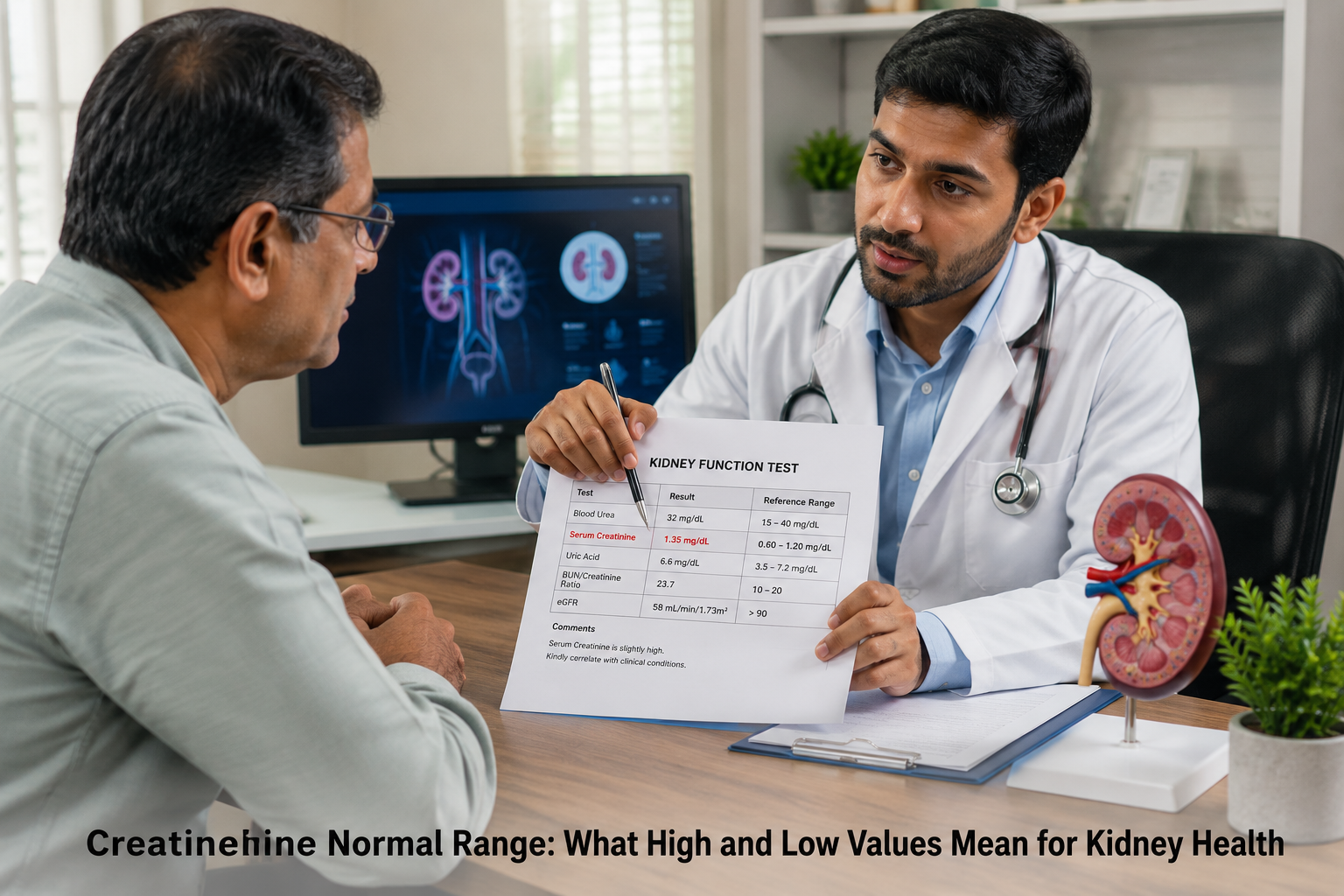
The serum creatinine normal range depends on your sex, age and muscle mass. Men usually have slightly higher levels than women, simply because they tend to carry more muscle. Here is a simple creatinine level chart to give you a rough idea.
Do remember, these figures shift a little from lab to lab. So always read your report against the reference range printed beside your result, and let your doctor interpret it in context.
Alongside creatinine, your report often shows eGFR, or estimated glomerular filtration rate. It uses your creatinine value, age and sex to estimate how much blood your kidneys filter each minute. A higher eGFR is better. When we assess kidney health, we look at creatinine and eGFR together, not just one number in isolation.
A raised level can mean many things, and not all of them are serious. Let me walk you through the usual high creatinine causes. The most common temporary reason is simply dehydration. If you were low on water before the test, your creatinine can read higher. A heavy protein meal or creatine supplements before the test, or an intense gym session, can nudge it up too.
Then there are the causes that need real attention. Long-standing diabetes and high blood pressure are the two biggest reasons for kidney damage in India, and both quietly raise creatinine over time. Chronic kidney disease, kidney infections, reduced blood flow to the kidneys from heart problems, and blockages like kidney stones or an enlarged prostate can all push the number up. Some painkillers, especially regular use of NSAIDs, can also strain the kidneys.
Low creatinine tends to worry people less. The most common low creatinine causes are simply having less muscle, whether from ageing, a low-protein diet, or a long illness. Pregnancy naturally lowers creatinine because blood volume rises. Serious liver disease can lower it as well. On its own, a mildly low level is usually nothing to lose sleep over, but your doctor will judge it alongside your overall health.
It starts with the blood test itself, the serum creatinine test, usually done as part of a kidney function test, or KFT. Your doctor may repeat it after a few days to rule out a one-off spike from dehydration. Often it is paired with eGFR, blood urea and a urine test to build a fuller picture. At UniClinic, a simple kidney function test can be done quickly, with home sample collection if getting to the clinic is hard. Our Nephrology team in Kolkata and the Nephrology team in Siliguri can guide you through your results and the right next steps.
This is the question everyone asks. But here is the honest answer, you do not chase the number, you treat the cause. Still, several steps genuinely help. Start with water. Staying well hydrated helps your kidneys flush waste, though do not overdo it if your doctor has restricted your fluids. Keep your blood sugar and blood pressure under tight control, because these protect your kidneys more than anything else.
Go easy on red meat and very high protein diets, and be careful with protein or creatine supplements. Avoid popping painkillers like NSAIDs on your own. And if you smoke, this is one more reason to stop. For anyone with kidney concerns, a diet lower in salt, and sometimes lower in potassium and phosphorus, may be advised. That plan should come from your doctor or a dietitian, not from the internet, because it depends on your reports. When we talk about how to reduce creatinine levels, consistency with these basics beats any quick fix.
If your creatinine is above the normal range, or your eGFR is dropping, please do not ignore it, especially if you have diabetes, high blood pressure, or a family history of kidney disease. Swelling in the feet, tiredness, changes in how much you urinate, or foamy urine deserve a check too. Early kidney trouble is often silent, so a timely test does the talking before symptoms even start.
For most adults, the serum creatinine normal range is about 0.7 to 1.3 mg/dL in men and 0.6 to 1.1 mg/dL in women. Always compare your value with your own lab's reference range.
For many adult men, 1.3 sits at the upper edge of normal. Whether it is a concern depends on your age, muscle mass, sex and eGFR, so your doctor reads it in context rather than in isolation.
Often yes, if the cause is temporary, like dehydration or a medicine. When it is due to long-term kidney damage, the goal shifts to protecting the kidneys and slowing further decline with good sugar and blood pressure control.
No. A single high reading can come from dehydration, a heavy workout or a protein-rich meal. Doctors usually repeat the test and check eGFR before drawing any conclusion.
Cutting back on excess red meat, very high protein diets, added salt, and creatine supplements can help. If your kidneys are affected, your doctor may also limit potassium and phosphorus.
Staying properly hydrated helps your kidneys clear waste and can correct a reading that was high due to dehydration. It is helpful, but it is not a cure for underlying kidney disease.
References & Citations
Max Healthcare (MaxAtHome) - Creatinine Normal Value and Kidney Health
National Kidney Foundation - Estimated Glomerular Filtration Rate (eGFR)
Mayo Clinic - Creatinine Test
National Institute of Diabetes and Digestive and Kidney Diseases (NIH) - Kidney Function Tests
MedlinePlus, U.S. National Library of Medicine - Creatinine Blood Test
Disclaimer: UniClinic does not represent or warrant that the content or information provided through our blog is accurate, complete, or current, nor that our blog content will be uninterrupted or error-free. We do not guarantee that any defects in our blog content will be corrected, or that our or the server hosting them are free of viruses or other harmful components. UniClinic makes no warranties or representations regarding the use of materials in our blog content concerning their correctness, accuracy, adequacy, usefulness, timeliness, reliability, or otherwise, to the fullest extent permitted by applicable law. Information available via our Platform and blog content may reference products, programs, or services not available in your region. You understand and acknowledge that your sole and exclusive remedy for any defect in or dissatisfaction with our blog content is to cease using them.
For test bookings and inquiries: Contact UniClinic
Cardiology | Endocrinology | Laparoscopic Surgery in Obstetrics & Gynecology | Gynecology & Obstetrics | General Medicine | Gynaecology | Orthopedics | Paediatrics | Diabetology | Ultrasound Imaging | Digital X-Ray | Blood Tests
Cardiology | Endocrinology | Laparoscopic Surgery in Obstetrics & Gynecology | Gynecology & Obstetrics | General Medicine | Gynaecology | Orthopedics | Paediatrics | Diabetology | Ultrasound Imaging | Digital X-Ray | Blood Tests
6C, Hazra Road, Near Sujata Smriti Sadan, Bakul Bagan, Kalighat, Kolkata, West Bengal 700026
90540 08864
63563 55500
70690 05888
Mon - Sat : 8am - 8pm
Sunday : 8am - 5pm
Quick Links
Company
Resources
Follow Us









.jpg)

 Meaning, Causes, Symptoms, Treatment & Types.png)